Blake's sudden blindness
The light house: A love storyBlake's sudden blindness is the novel's great reversal: after months or years in which failing sight has remained a feared possibility, he wakes on the last day of summer to find that the world has become completely dark. The event destroys the fragile happiness he and Connie Dixon have built, but it also compels Blake to confront grief, dependence, and the meaning of his art without the visual power on which his career was founded.
Causes and Anticipation
Blake's blindness does not arrive without warning. He had first noticed his vision blurring several years earlier, but, because he was young and felt invulnerable, he dismissed the symptom. By the time he speaks to Connie, close-up focus is disappearing even though his long-range vision remains comparatively clear; he describes the process as if his eyes were dying from the inside out. He reads extensively in preparation for the possibility that he will soon be unable to see, and he asks to paint Connie because he believes her portrait may be his last painting and his last chance for redemption.
The diagnosis is therefore both physical fact and moral interpretation. Blake initially understands the coming blindness through the language of punishment. After Chloe drowned, he had abandoned the ocean, then abandoned painting and the wider world, believing that God had taken his daughter because he had failed to appreciate or love her adequately. When his sight begins to fail, he interprets the loss as a second punishment for having ignored his artistic gift. His blindness is thus attached to two forms of guilt: the guilt of the bereaved father and the guilt of the artist who has refused to work.
The Moment of Loss
The anticipated crisis becomes immediate when Blake wakes and realizes that he is utterly blind. The shock is intensified by the contrast with the preceding happiness: Connie's dream of painting has been rekindled, their gallery is nearing its opening, and their beach house has become a home in which laughter and loving conversation have begun to drown out the sounds of sorrow. In an instant, that renewed life collapses into terror and despair.
Blake tells Connie, "Connie, I’m blind." The short statement records the physical fact while exposing its emotional enormity. He sits up, gropes for his jeans, and rises on shaking legs, breathing in short, shallow breaths. His terror soon turns into rage. He blunders through the house, overturning furniture, crashing into the sofa, shattering a glass, and falling when a rug slips beneath him. Objects that had previously been transparent parts of domestic life suddenly become obstacles: the sofa, glass, rug, walls, and doorway announce their material presence by obstructing his movement. His loss of sight changes not only what he can perceive but also how the house acts upon his body.
In a closet he finds the cane that eye specialists had given him many years before. He grasps it angrily and wields it like a sword, an object intended to provide orientation becoming an emblem of his resistance to the condition it represents. He screams against the injustice of what has happened, kicks open the screen door, and leaves the house while Ned cowers and Connie remains trembling and helpless behind him.
Flight into the Storm
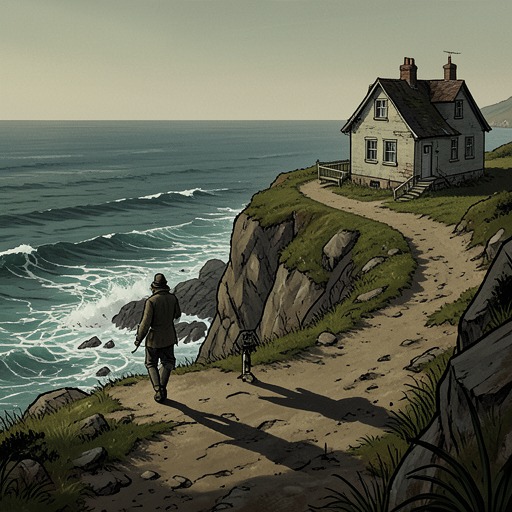
Blake stumbles down the stairs and falls into the sand as rain begins to strike him. Swinging the cane, he descends toward the beach, falling repeatedly and dragging himself upright each time. His cries and exhaustion reduce him to a small, broken figure beneath a boiling gray sky. For a day and a night he wanders the deserted shoreline while storm winds snarl, rain thickens into mist, lightning flickers, and distant thunder rolls like muffled cannon fire.
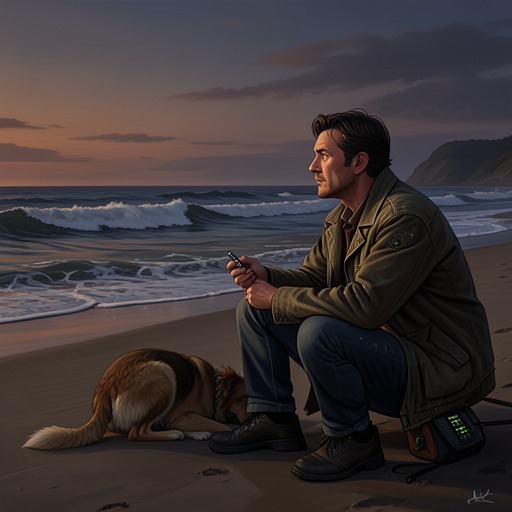
The beach is crucial because it joins the two losses that govern Blake's life. It is the source of the seascapes that made his career, but it is also the place associated with Chloe's drowning. Before the blindness, Blake and Ned had gone to the beach at sunset to send a rose into the sea, while Ned remained through the night waiting for Chloe. Blake had left the lights on at the house so that his daughter might find her way home. These repeated actions preserve an emotional bond with the dead, yet they also keep Blake oriented toward the past. His blind wandering through the storm turns the same shoreline into an external image of his grief: he is still moving, but without direction, repeatedly collapsing and forcing himself onward.
Connie watches from the window, keeping vigil as Blake appears and disappears near the rocky headlands. The tide erases his footprints during the night, making his desperate passage visibly temporary and emphasizing the exhaustion of a struggle that cannot restore his sight. By morning, he is haggard, numb, and repeatedly falling. Connie can no longer remain a distant witness; she goes down toward the beach because their love has become inseparable from the question of whether Blake will permit another person to accompany him through darkness.
Consequences and Reorientation
The blindness threatens to turn Blake's isolation into permanent defeat, but the narrative does not treat it as the end of his relationships or his public life. Earlier, revealing his failing sight and the history of Chloe's death had already begun to release him from private pain. After sharing that grief with Connie, he experiences a brief lifting of the burden and senses his former self rising from despair. The sudden blindness violently interrupts that recovery, yet it also makes concealment impossible: his body, his anger, and his dependence all become visible to Connie.
The crisis eventually leads Blake back toward Chloe rather than allowing him simply to erase her. He tells Connie that he must say the one thing to Chloe he had never been able to say: goodbye. At sunset he returns to the beach with Ned and the last red rose. The ritual does not cancel the continuing bond with his daughter; it changes its form. The rose and the shoreline become instruments of farewell rather than endless waiting, allowing memory to coexist with a future that includes Connie.
Blindness also changes the conditions under which Blake can participate in the world. At the gallery, he uses his cane and slowly moves around the walls, counting paces and memorizing distances while Connie manages practical arrangements with the catering staff. His disability requires new spatial habits and assistance, but it does not remove his agency. Even his dry recognition that being blind may be advantageous when Connie drives too fast shows the emergence of adaptation within catastrophe: the loss remains real, but it no longer defines every possible response.
Artistic Transformation
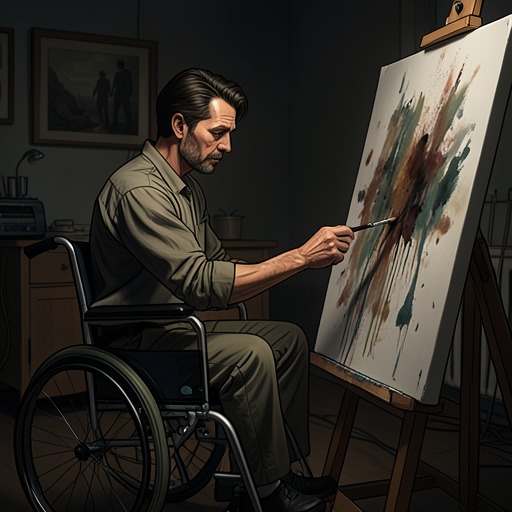
Blake first believes that blindness means the end of his artistic career. At the gallery opening, however, he declares that he will return to the easel, not to reproduce the seascapes or portraits by which he was previously known, but to paint emotion. He explains that his earlier works evoked feeling through visible scenes such as dramatic seascapes and beach sunsets. Without sight, he cannot recreate those images to his own standards, but he can attempt to look inward and place raw movement and color on canvas as the essence of feeling.
This decision transforms blindness from a punishment into a difficult artistic condition. It does not make the loss desirable, nor does it pretend that Blake's former practice can simply continue unchanged. Instead, the event forces a distinction between painting scenes that cause emotion and painting love, loss, hope, and sadness directly. His new ambition is to strip away visible images as emotional supports and give shape and color their own expressive power.
The portrait of Connie therefore becomes more than a final work made before darkness. It is the bridge between Blake's old career and his proposed new practice, between private redemption and public declaration. He tells the gallery audience that he painted Connie because he wanted redemption, then announces that he will paint again because without art some part of him will always yearn to be heard. The sudden blindness closes one artistic life, but it opens a different conception of what an artist can perceive and communicate.